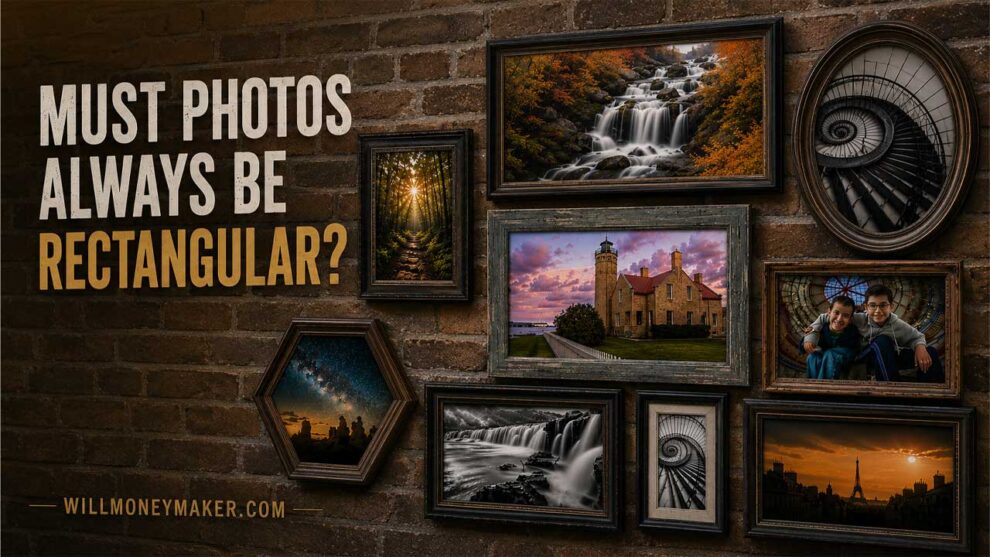
When you look around at photography, whether it is printed or digital, your work or someone else’s, you’ll see that most prints are one of the common standard sizes or aspect ratios, and nearly all of them are rectangular, either horizontal or vertical. Those certainly aren’t the only shapes we're limited to, so why do prints nearly always come in these sizes? Let’s examine some of the reasons, starting with a brief lesson on how some of the most common print sizes or aspect ratios came to be.
Print Sizes and Their History
When you look at some of the most common sizes — and the proportional aspect ratios that match them — you’ll find that most of these sizes originate with a historic camera type that used film of that size. Take, for instance, the popular 8×10 size. This size comes from the old large-format cameras, such as those Ansel Adams would have used, which used film that came in 4×5-inch sheets. One popular large-format 4×5 camera was the Graflex Speed Graphic. From those cameras, we got the 4×5, 8×10, 12×15, and 16×20 print sizes. All of the larger measurements are simply larger aspect ratios of those 4×5-inch film sheets.
The 5×7 aspect ratio came into being in the same way, starting with cameras like the Rochester Optical Co. Universal Camera, a 5×7 folding view camera introduced in 1890. At the small size, you’ll find this format in 2-1/2×3-1/2-inch prints, while at the larger size, you’ll find 10×14-inch and 20×28-inch prints. This aspect ratio is used by another type of large-format camera, such as those used for documentation by the National Park Service. Like 4×5 or even 8×10 large format cameras, these used sheet film, but film that measured 5×7 inches.
Later, with the advent of 35mm cameras, the 2×3 format became more popular. Among the first 35mm cameras available to consumers was the Tourist Multiple in 1913. This size is old, but nowadays it is the aspect ratio most modern DSLRs use, giving you 4×6, 6×9, 8×12, and 10×15 print sizes and up.
The bottom line is that for almost every print size you can choose, it has a historical basis in a camera that used and popularized the aspect ratio.
Photography Clips Newsletter
Get my latest articles, thoughts on photography and creativity, and Photography Clips episodes in your inbox.
Are There Other Reasons Why Rectangular Prints Are Standard?
One reason that prints are usually rectangular, or at the very least, square, could very well be because compositional rules are often designed to work better with the rectangle. Think about the Rule of Thirds for a moment. How would you apply it to a triangle or a circle?
Circular designs, in particular, tend to feel more normal and easy to understand when the subject material is centered, but as photographers, we are taught to avoid centering our subjects unless the image really calls for it. Consequently, you really only see round or oval images in portraiture, and even then, usually among older portraits and not modern works.
So are these the reasons why images tend to be rectangular? Certainly, older film formats played a larger role in determining print sizes, but perhaps the reason we don’t stray from those old print sizes is compositional difficulty.
Another issue may simply be ease. Today, with all our technology, it is still easier to cut prints with nice, straight edges and to make a square picture frame than to mold wood into a round or oval shape. In the digital age, everything, from our phones and computer monitors to televisions, billboards, and digital picture frames, is rectangular. What better way to fill a screen than to use an image that is a similar shape to that screen? It is simply easier to make and display a rectangle than any other shape.
Should We Hesitate to Make Unusual Shapes?
As with any other rule of art, the answer to that question is maybe, and maybe not. Certainly, the rectangular shape is popular for all of the reasons I have listed and then some. But perhaps it is time to bend the rules a bit.
We already see this happening with some image types. Panoramas, for instance, are becoming more popular, and even though they are rectangular, they are much longer and narrower than any of the more common aspect ratios. Square imagery is another option, one that lets you explore the idea of centric photography without creating circles.
Then, you have the idea of multiple shapes. Diptychs and triptychs, for instance, are also still mostly rectangular. However, when designing these, you can use rectangles of varying proportions.
But what about the more unusual shapes? Circles, ovals, triangles, even trapezoids. Is there value to these shapes, artistically or practically? The only way to find out is to experiment.
I tend to believe that in most instances, unusual shapes are likely to make the subject material feel constrained, or “boxed in,” simply because we are used to seeing the edges of the image that you will end up cropping out to make your new shape. I also think, however, that this could prove to be an interesting challenge to the rules of composition. Perhaps even a way to develop new rules, or add to rules that haven’t changed in centuries.
Throughout history, it has mostly been photographers willing to challenge the rules of composition who have made something new and revolutionary. So, perhaps this idea is one worth a little more thought. And, for those of you bold enough to break the rules, perhaps it is an idea worthy of experimentation!
Photography Clips Newsletter
Keep looking. Keep creating.
Follow along with my photographs, journal entries, Photography Clips, and occasional life updates.
Free to join. Unsubscribe anytime.